Free Playbook

The AI Answers Playbook

Is AI sending your customers to a competitor?

Customers used to search the Yellow Pages. Then they searched Google. Now they ask AI. When someone asks an AI tool who to call, who to trust, or who is best near them, your business may be part of the answer — or a competitor may get the call. Here are 7 practical checks to run before someone else becomes the default answer.

Free to read below • PDF needs no card • Powered by AIFSO

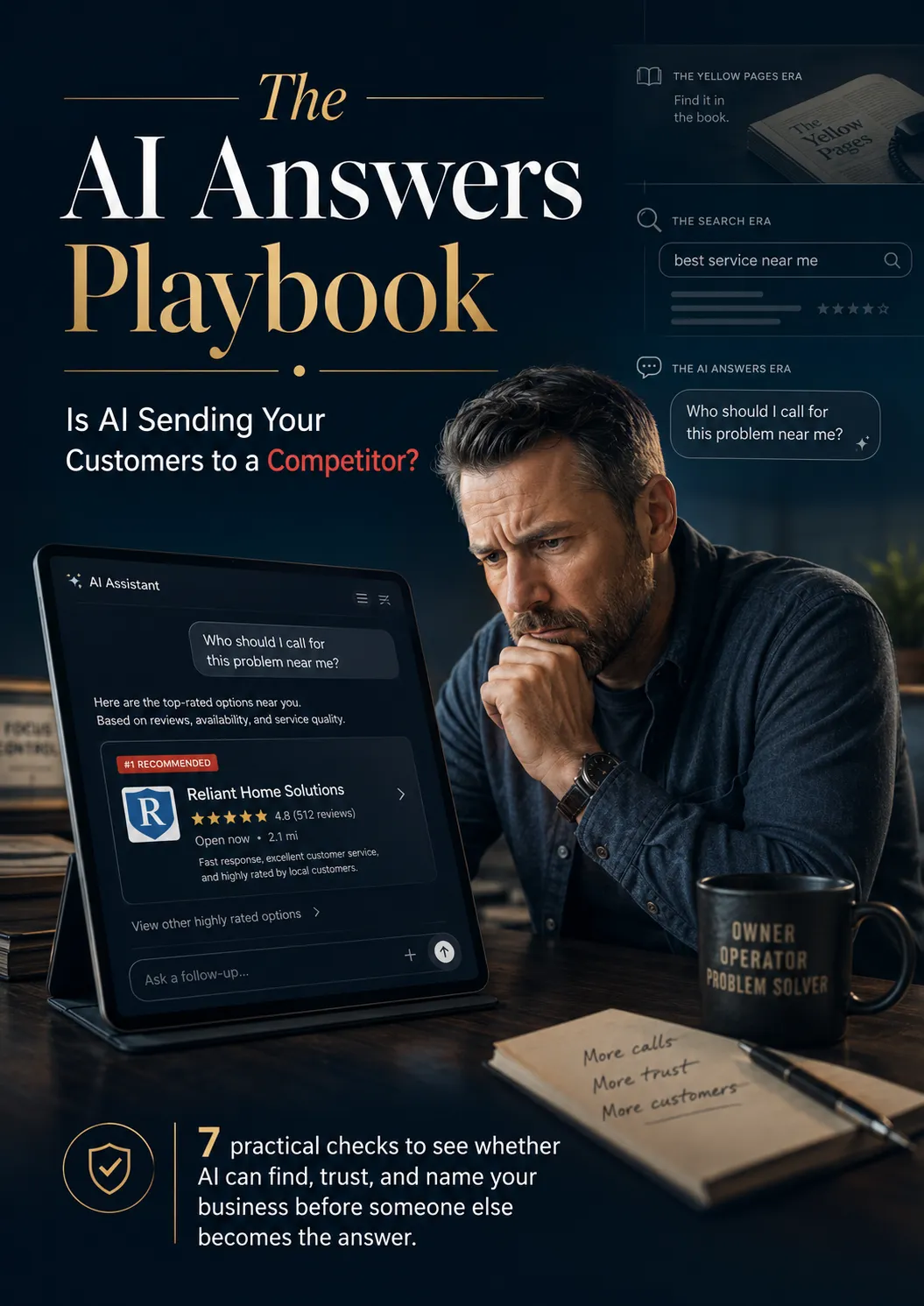
The AI Answers Playbook cover — a business owner sees an AI answer name a competitor instead of their business.

Opening hook

Read this before your competitor becomes the answer

AI answers are becoming the next major discovery shift for owner-led businesses. Buyers are no longer only scrolling search results — they are asking AI who to call, who to trust, and who is worth hiring.

Most websites were built for humans and search engines. That still matters. But AI visibility depends on something deeper: whether AI can find your business, understand what you do, trust your evidence, and actually name you when a buyer asks a real question.

A good-looking website can still be invisible to AI. Strong services, real reviews, and years of experience do not automatically translate if those signals are vague, scattered, or hard for AI to use.

Fast takeaway

If you do nothing else after reading this guide, run your free AIFSO Glimpse. It gives you a useful first look at visible AI-readiness, foundation, and authority signals. It does not run Prompt Intelligence or test AI model answers — that proof is reserved for the Full AIFSO Report.

A business owner studies an AI assistant naming a competitor while their own business is missing.

The new discovery map

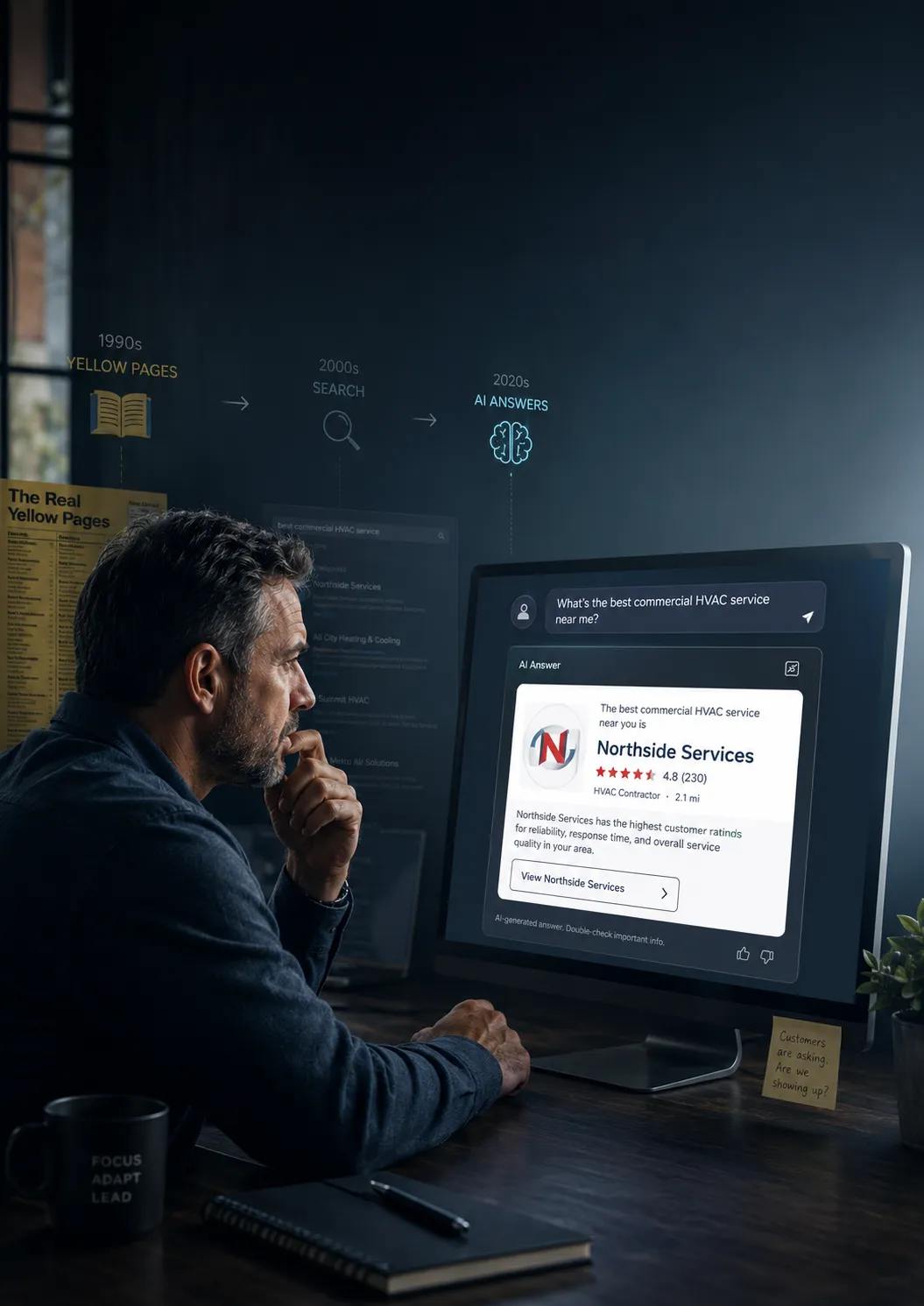
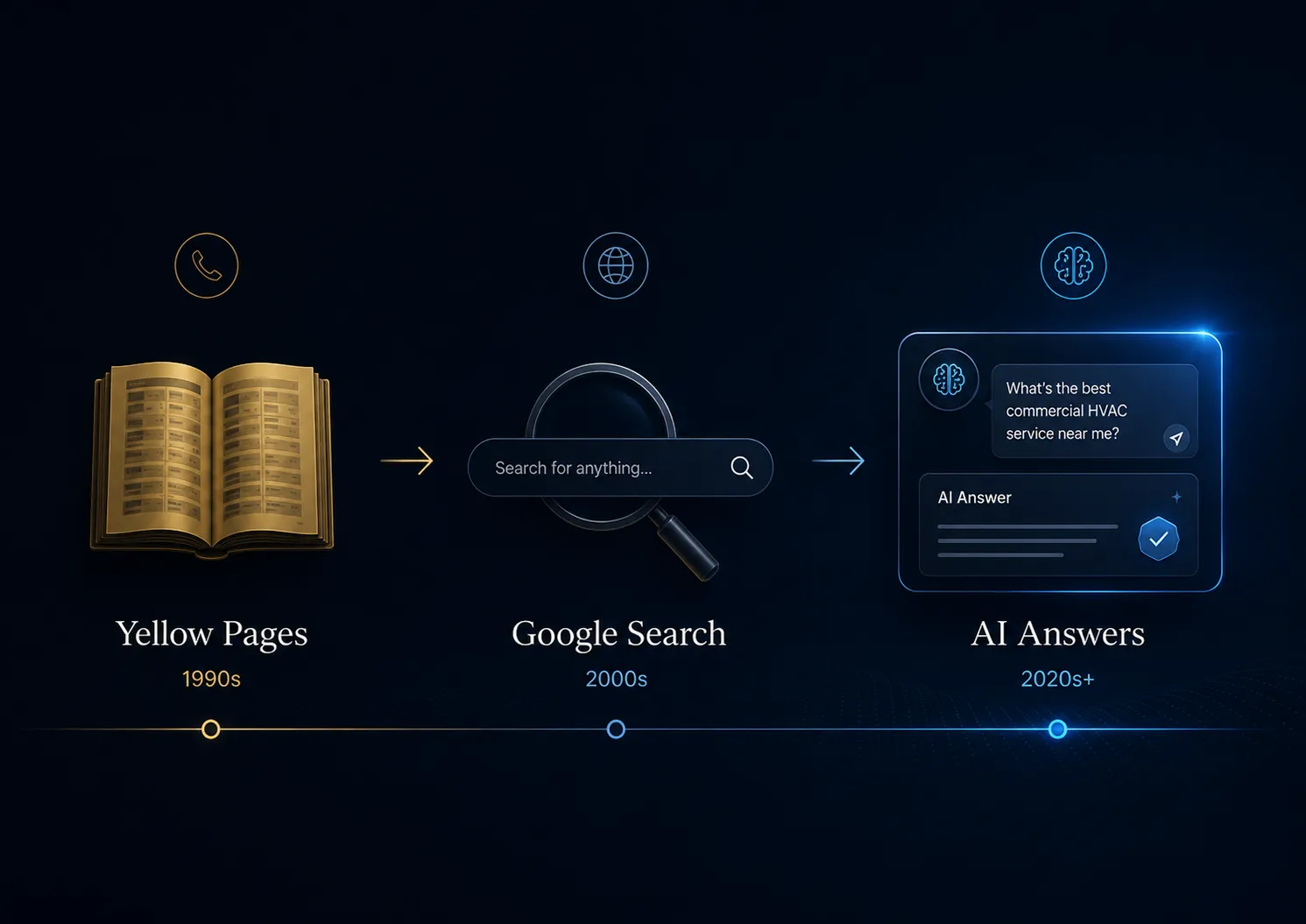
Yellow Pages → Google → AI answers

Every time the map changed, some businesses moved early and gained an edge. Others waited and had to catch up later. AI answers are becoming the next map.

Timeline of customer discovery: Yellow Pages in the 1990s, Google Search in the 2000s, and AI Answers in the 2020s and beyond.

The real business question

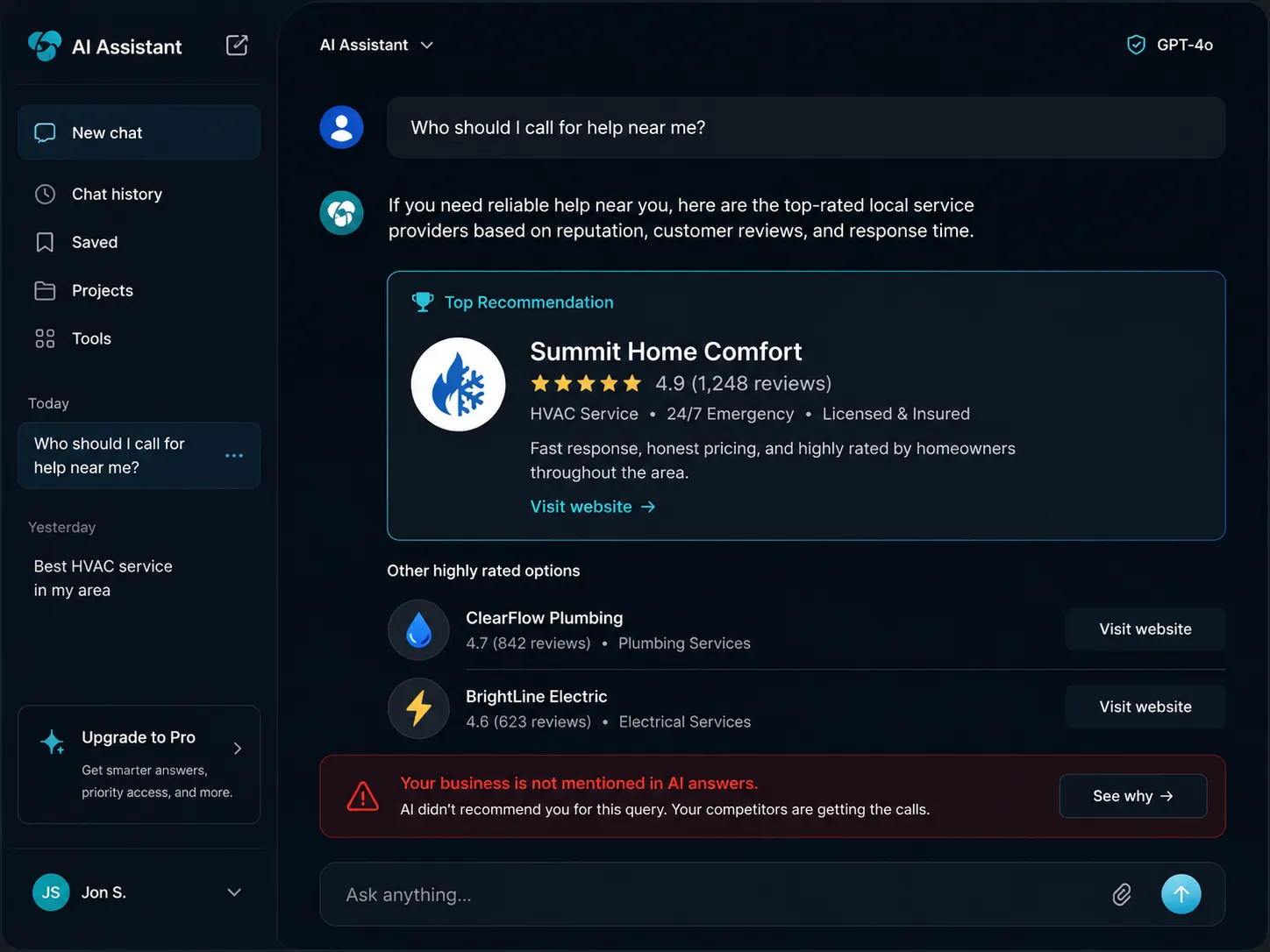
When someone asks AI, “Who should I call for this problem near me?” does AI name your business, name a competitor, or skip you entirely?

What this playbook covers

A plain-English first pass

This guide will not replace a full visibility report, but it will help you understand the kinds of signals AI systems look for when deciding whether to recommend a business. You will check whether:

Important truth

A good-looking website does not automatically mean AI can find you, understand you, trust you, or recommend you. Clean design and classic SEO are not the same as AI-answer proof.

The 7 checks

Run these before competitors become the default answer

1

Can AI tell exactly what you do?

If your homepage or service pages are vague, overloaded, or built around slogans, AI may not clearly understand your business. A human can sometimes interpret clever marketing copy. AI needs clear evidence.

Warning signs

  • Your homepage talks in broad brand language instead of clearly stating services.
  • Your top service pages are thin, generic, or missing.
  • Your site uses slogans instead of direct explanations.
  • A stranger would struggle to explain your business in one sentence after reading your site.

What good looks like

A strong page quickly answers: what you do, who you do it for, where you do it, and why someone should trust you.

Fix first: Add a clear one-paragraph answer near the top of your homepage and top service pages.
2

Can AI tell where you work?

Local intent is one of the biggest openings for owner-led businesses. But AI cannot recommend you locally if your site and profiles do not make your geography obvious.

Warning signs

  • Your city, region, or service area is barely mentioned.
  • Your site says “serving the area” without naming the area.
  • Your website, Google Business Profile, and contact page use different location signals.
  • Location-specific examples, proof, or service pages are weak or missing.

What good looks like

Your service area is obvious on the homepage, your service pages name where each service is offered, and AI can tell whether you serve nearby areas.

Fix first: Add clear service-area language to your homepage, footer, service pages, contact page, and relevant structured data. Do not make AI guess where you work.

3

Do your business facts match everywhere?

AI does not only read your website. It may compare your business across maps, profiles, directories, reviews, social pages, and structured data. If your facts conflict, AI has more reason to hesitate.

Warning signs

  • Business name, phone, URL, address, category, hours, or services differ across listings.
  • Your Google Business Profile, Apple Business Connect, and Bing Places disagree.
  • Your structured data (schema) does not match what is on the page.

What good looks like

One source of truth for your core facts — name, phone, URL, address or service area, category, hours, main services — aligned everywhere.

Fix first: Choose one source of truth for your business facts. Then align your website, profiles, directory listings, and structured data to that truth.

4

Do your pages answer real buyer questions?

AI answer systems favor content that can be extracted, summarized, and trusted. If your pages are only sales copy, you make AI work harder.

Warning signs

  • Pages answer no specific buyer questions — only pitch.
  • No pricing context, no “do you serve my area,” no “how fast can you help.”
  • No clear statement of what makes you different, or your qualifications.

What good looks like

Each important page includes direct question-and-answer blocks, clear headings, concise paragraphs, and proof close to the claim.

Fix first: Add direct answer sections to your homepage and top service pages. Use the customer question as the heading, answer it plainly, then support it with proof.
5

Do you show proof AI can trust?

AI is more likely to use businesses that show evidence, not just claims. A claim says what you want people to believe. Proof gives AI and customers a reason to trust it.

Warning signs

  • Strong claims with no proof nearby.
  • Thin About page; no visible team credibility.
  • No review proof on service pages; no real examples of work or outcomes.

What good looks like

Reviews, testimonials, before-and-after photos, awards, certifications, case studies, years in business, and local project examples — placed near the claims they support.

Fix first: Add proof blocks near the claims they support. Do not bury reviews, credentials, and project examples where AI and customers have to hunt for them.

6

Can AI access your content?

Even strong content can fail if crawlers, search engines, or AI systems cannot access or interpret it well. This is where the foundation starts to matter.

Warning signs

  • Broken internal links, thin or missing text, important content trapped in images.
  • Heavy JavaScript that hides the message; weak crawl structure or bot restrictions.
  • Technical errors; missing or weak structured data.

What good looks like

Important content is visible as text, important pages are easy to reach, service pages are clearly linked, and machines get clean facts instead of guessing.

Fix first: Make important content easy to reach, easy to read, and easy to interpret. A clean-looking site that hides meaning from machines can still lose in AI answers.

7

Are competitors easier for AI to recommend?

This is the question most business owners never ask. You may not be losing because you are invisible everywhere. You may be losing because a competitor is easier for AI to understand, trust, summarize, and recommend.

Warning signs

  • A competitor has clearer service pages and better review momentum.
  • A competitor shows stronger proof and better local specificity.
  • A competitor has more complete profiles and better answer-style content.

What good looks like

You can ask AI “who is best for this service near me?” and know whether you were named, skipped, or replaced — and why.

Fix first: Stop treating AI visibility as a mystery. Start treating it as a measurable business problem: who did AI name, who appeared instead, and what signal gap may explain it?

A dark-mode AI chat recommends competitors like Summit Home Comfort while warning that your business is not mentioned in AI answers.
When AI answers a buyer’s question, your business is either named, skipped, or replaced by a competitor.

The blind spot

What most SEO audits miss

classic_seo

Can your site compete in search results?

A normal SEO audit asks: Do you rank? Do you have backlinks? Is your page fast? It still matters — but ranking is no longer the complete picture.

ai_answer_visibility

Can your business become the answer?

AI Answer Visibility asks: Can AI understand your business? Can AI trust your evidence? Does AI actually name you — and who gets named instead?

Meet AIFSO

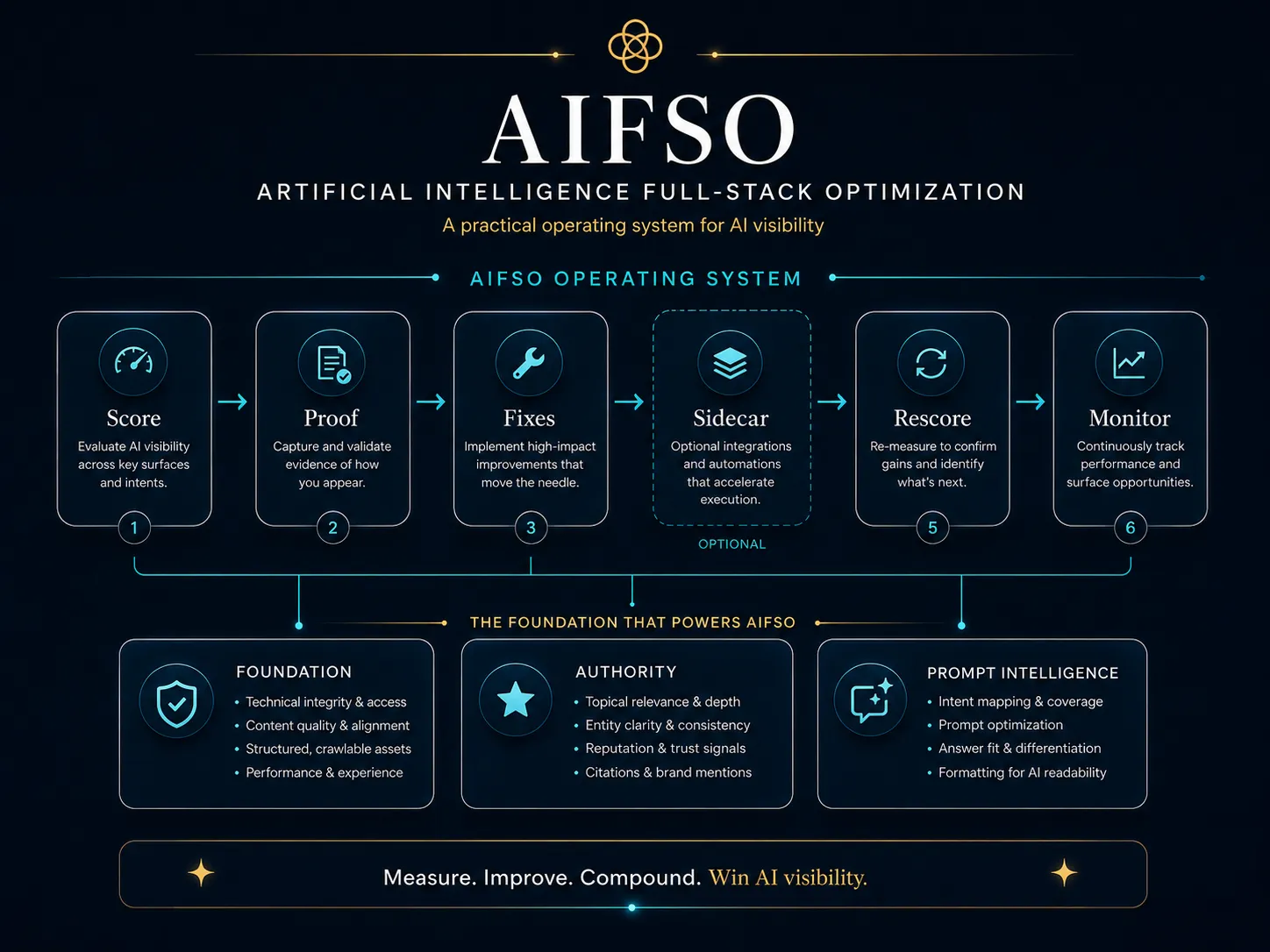
Artificial Intelligence Full-Stack Optimization

The proprietary system behind how AI Answer Sites evaluates whether AI can find, understand, trust, and name your business when customers ask real buyer questions.

foundation

Foundation

Can AI access, read, and understand your site?

authority

Authority

Does your business have the trust signals, consistency, and credibility AI looks for?

prompt_intelligence

Prompt Intelligence

When real buyer questions are asked, does AI name your business, miss it, or recommend someone else?

The AIFSO operating system: Score, Proof, Fixes, optional Sidecar, Rescore, and Monitor — supported by Foundation, Authority, and Prompt Intelligence.

The simplest AIFSO explanation

Can AI read you? Can AI trust you? Does AI name you? See how it works →

Self-check worksheet

Your AI answer visibility self-check

Give yourself 1 point for each “yes.” This is not a Full AIFSO score — it is a practical readiness worksheet to help you spot obvious gaps.

QuestionYesNo
My homepage clearly says what we do.
My site clearly explains where we serve.
Our business facts match across key profiles.
Our pages answer buyer questions directly.
We show trust proof near important claims.
Our content is easy for AI to access and interpret.
We know whether competitors are being named instead.

0–2 yeses: You may already have serious AI-answer gaps.

3–5 yeses: You have a starting point, but important gaps remain.

6–7 yeses: You may have strong readiness — but readiness is not proof.

Why proof matters

A business can look clean and still fail to get named. That is why real Prompt Intelligence matters in the Full AIFSO Report.

Try it yourself

10 questions to ask AI about your business

Open ChatGPT, Gemini, Claude, or Google AI tools and test a few buyer-intent questions. Results vary by location, timing, phrasing, and engine — treat this as a directional exercise, not a complete audit.

  1. Who is the best provider for this service near me?
  2. Who should I call for this urgent problem in my area?
  3. Top-rated businesses for this service near me.
  4. Who offers this service in my area?
  5. What company is trusted for this service in my area?
  6. Who has the best reviews for this service near me?
  7. What should I know before hiring a provider like this?
  8. Who handles emergency help for this problem?
  9. What is the typical cost of this service, and who offers it nearby?
  10. If I needed help with this today, who would you recommend?

For each answer, write down

Was your business named? Was a competitor named instead? Was the answer accurate? Did AI understand what you do? Did the answer sound confident?

What you unlock

The Full AIFSO Report is the proof layer

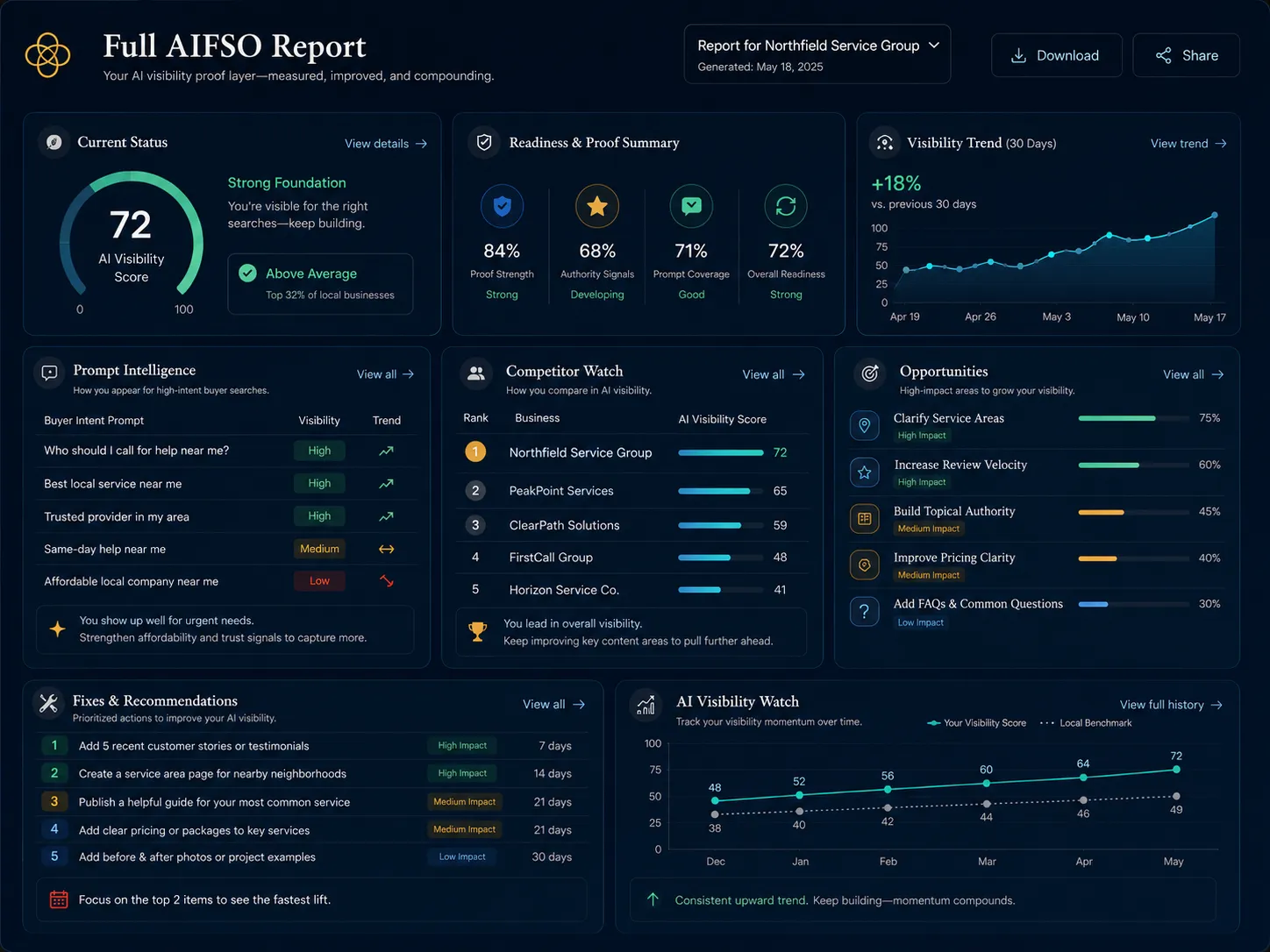
Where the free Glimpse shows visible readiness signals, the Full AIFSO Report tests whether AI actually names you — and shows who appears instead.

A preview of the Full AIFSO Report dashboard with Current Status, Prompt Intelligence, Competitor Watch, Opportunities, Fixes & Recommendations, and AI Visibility Watch.

Your move

Fix first. Build next. Watch monthly.

The goal is not to chase every new AI trend. Fix the highest-leverage gaps first, then watch whether your visibility improves over time.

fix_first

Fix first

Clarify what you do and where you serve, align business facts across profiles, make content easy for AI to read, add proof near your claims, and answer real buyer questions.

build_next

Build next

Strengthen service and answer pages. Consider a Sidecar — an optional AI-answer layer that sits beside your existing website.

watch_monthly

Watch monthly

Use the Full AIFSO Report as your baseline, with 1 year of AI Visibility Watch follow-up checks so your first report is a baseline, not a snapshot.

Start here

Find out what AI says about your business.

The free AIFSO Glimpse takes a minute and needs no card. When you are ready for the truth, the Full AIFSO Report shows whether AI names you — and what to fix first.

Get My Free Glimpse Report

Free Glimpse Report • No card needed

See the Full AIFSO Report

$79 includes the initial Full AIFSO Report plus 1 year of AI-visibility follow-up checks.